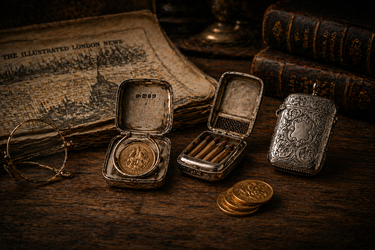
Discover a curated collection of rare, unique and precious Silver Sovereign holders and Vesta cases. Each unusual piece has endured time to survive as antiques and a glimpse of British history, with many items dating back to the 19th Century.
Browse through our curated collection of solid Silver sovereign holders and vesta cases, and own a piece of British history. Each rare, collectable case or holder offers a unique opportunity to own a limited one-of-a-kind antique.
A Glimpse Into a Forgotten Era of Everyday Luxury
At Serendipity Diamonds on the Isle of Wight, our collection of sovereign holders and vesta cases is a quiet celebration of an age when even the most ordinary objects were made extraordinarily well. These diminutive silver pieces offer more than a window into the late Victorian and Edwardian eras — they offer a way to hold that world in the palm of your hand.
In the late nineteenth and early twentieth centuries, gold sovereigns and half sovereigns were the currency of daily life. Rather than left to rattle loosely in a pocket, they were kept in purpose-built cases of considerable ingenuity — spring-loaded mechanisms that secured and dispensed each coin with satisfying precision. That so many of these mechanisms survive in perfect working order today is a testament to the exacting standards of British craftsmanship at its finest.
Vesta cases served an equally practical, equally elegant purpose. When striking a flame was a part of every waking hour, these compact silver companions kept matches safe and dry, their striker plates often adorned with engine-turned patterns or delicate engraved detail. Small in scale, but never small in ambition.
The finest examples bear names that resound through the history of British silverware — Joseph Gloster Ltd, Deakin & Francis, Sampson Mordan & Co, and William Vale & Sons among them. Hallmarks from the assay offices of Birmingham, Chester, and London offer a traceable and intimate connection to their precise origins, transforming each piece into a small but legible document of its time.
At Serendipity, we select these antique pieces with care, choosing examples that balance historical significance with enduring, everyday appeal. Once indispensable tools of modern life, sovereign holders and vesta cases have gracefully become something else entirely — collectables of quiet distinction, worn today as pendants or kept as conversation pieces that carry the texture of another century within them.
Every piece has its own story to tell. Whether it speaks of mechanical ingenuity, maker's pride, or simply the pleasure of a beautifully made thing, these antique silver designs feel as relevant now as they did over a hundred years ago — a subtle, enduring bridge between history, craft, and the way we choose to live today.
browse in store
Visit us on the Isle of Wight
Discover more when you visit our showroom on the beautiful Isle of Wight. Browse designs in store and enjoy expert help and guidance. Drop in or book a dedicated appointment with our team.
A silver sovereign holder is a small, pocket-sized case designed to hold a gold sovereign coin. Popular during the late 19th and early 20th centuries, they protected coins from wear and made them easy to carry.
What is a vesta case?
A vesta case is a compact container used to store matches (called “vestas”) before modern lighters became common. Most antique examples
Are sovereign holders and vesta cases the same thing?
No. Sovereign holders are designed specifically for coins, while vesta cases were made for matches. However, both are similar in size, craftsmanship, and often collected together.
What were sovereign holders used for historically?
They were used to safely carry gold sovereign coins, which were commonly used in everyday transactions during the Victorian and Edwardian eras.
Are antique silver vesta cases still usable today?
Yes. Many antique vesta cases remain fully functional and can still hold matches, though they are more commonly used as collectible or decorative items today.
Are antique silver vesta cases still usable today?
Look for British hallmarks, typically stamped inside or along the edge. These marks indicate the metal purity, assay office, and date of manufacture.