
Where to Buy Matching Pairs of Blue Diamonds
Serendipity Diamonds provides a dedicated service to find and match pairs of blue diamonds, with colour examples available on the Serendipity Jewellery website.
Finding matching pairs of blue diamonds for jewellery can be surprisingly difficult. Whether intended for earrings, trilogy rings or bespoke jewellery commissions, blue diamond pairs require careful matching to ensure consistency in colour, shape, cut and overall appearance.
Whether you're after a pair of diamond studs, a trilogy ring, or side stones for a bespoke design, matching blue diamonds takes a trained eye and a fair bit of patience. Colour, shape, size and cut all need to line up — and blue diamonds are far less forgiving than white ones when it comes to spotting the differences.
At Serendipity Diamonds, we help clients find and match pairs of blue diamonds from our online diamond search facility. You can search for stones yourself using our online diamond search, then we'll take over the detailed work of comparing and confirming the best possible match.

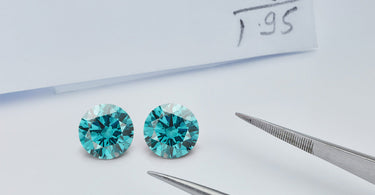
A matching pair of small lab-grown blue diamonds photographed on a diamond sorting tray for our client.
What Do We Mean by a "Matching Pair"?
A matching pair of blue diamonds is two stones chosen to look like twins when placed side by side.
That's a more involved job than it sounds. We're not just measuring carat weight and calling it done — we're comparing shape, dimensions, cut quality, and colour, right down to how evenly that colour sits across each stone. Two diamonds can be the same on a certificate and still look noticeably different in real life.
Blue diamonds generally fall into three categories: natural stones coloured by nature, natural diamonds treated after mining to bring out a blue colour, and lab-grown diamonds treated to develop a permanent blue. Of the three, lab-grown blue diamonds are by far the most popular choice for matched pairs today, simply because they're more consistent, more affordable, and easier to find in the sizes people want.
Why Matching Blue Diamonds Is Trickier Than It Looks
White diamonds are graded on a fairly straightforward colour scale. Blue diamonds aren't so simple — saturation and tone can vary quite a lot between stones that would both fairly be called "blue."
Put two side by side and you'll often notice one looks slightly greener, slightly darker, or just a touch more vivid than the other. It's subtle, but it's exactly the kind of thing that stands out once a pair is set into jewellery — especially in designs where symmetry matters, like diamond studs, trilogy rings, three-stone dress rings, or shoulder-set engagement rings.
This is really where experience counts. We look at every candidate diamond individually before we'll recommend it as part of a pair.

Several loose blue diamonds compared side-by-side
How Important Is a Perfect Match?
The importance of matching depends partly upon how the diamonds will be worn.
For earrings, slight colour variations can be less noticeable because each diamond is worn on opposite sides of the face. Even so, differences can still become apparent under certain lighting conditions.
Rings present a greater challenge. In trilogy rings and three-stone designs, diamonds sit immediately beside one another, making even subtle differences in colour intensity, saturation or size easier to detect.
For this reason, we aim to achieve the closest possible match regardless of whether the diamonds are intended for earrings, rings, pendants or another bespoke jewellery design. Our matching process does not change according to the finished piece. Every pair receives the same careful attention to colour, proportions and overall appearance.
Understanding Blue Diamond Colour
The strength of colour in a blue diamond changes its whole character. A subtle pale blue adds a gentle contrast next to white diamonds. A deep, vivid blue becomes the focal point of the design in its own right.

Grading systems can vary depending on where a diamond comes from and how it's certified, and that's part of why two diamonds that look fine on paper don't always match in person.
Natural vs Lab-Grown: Which Is Easier to Match?
Natural blue diamonds are some of the rarest diamonds you'll find anywhere. That rarity is exactly what makes matching pairs so difficult — and so expensive. Natural blue pairs tend to be reserved for serious, high-value commissions and collector pieces, simply because finding two that genuinely match is rare in itself.
Lab-grown blue diamonds have changed the picture considerably. They're more affordable, more readily available, come in larger sizes, often show stronger colour saturation, and — crucially for this article — they're much easier to match well. That's opened up vivid blue diamond jewellery to a lot of people who'd never have been able to consider it otherwise.
Why Blue Diamond Pairs Suit Trilogy Rings So Well
One of the nicest uses for a matched blue pair is in a trilogy ring. Two blue diamonds set either side of a white centre stone create real contrast and pull the eye straight to the centre — it can turn a fairly classic ring design into something genuinely individual.
Some combinations we see often:
Round blue diamonds either side of a round white centre stone. Pear-shaped blue diamonds flanking an oval centre. Trapezoid blue diamonds beside an emerald-cut centre stone. Cushion-cut blue diamonds with a brilliant-cut centre.
View some of our bespoke blue diamond engagement rings on the Serendipity Diamonds website

Trilogy ring with matched blue side diamonds
Choosing a Metal for Blue Diamonds
Blue diamonds work well across most precious metals, though each gives a slightly different effect.
Platinum and white gold stay out of the way and let the blue do the talking — a neutral backdrop with nothing competing for attention. Yellow gold does the opposite: it brings warmth into the design and creates a striking contrast against a vivid blue stone. A lot of our clients end up somewhere in between, combining yellow gold and platinum in the same piece to get a bit of both.

Blue diamond trilogy ring in yellow gold and platinum
How to Buy a Matching Pair of Blue Diamonds
The simplest starting point is our online diamond search. Use the filters to narrow down your search by fancy colour and shape, with options for the intensity of colour and carat weight.
Have a browse, shortlist the stones that catch your eye, and get in touch with our team once you've found a few you like the look of.
From there, we take over the detailed work — comparing colour consistency, checking dimensions and proportions side by side, and confirming whether a pairing genuinely works before we recommend it to you. Where it's useful, we can also provide colour-balanced photography, comparative images, and 360-degree video so you can see exactly what you're considering, along with design guidance if you're working towards a bespoke piece.
Search for Blue Diamonds Online
Finding suitable blue diamonds begins with our online diamond search facility. Clients can browse a wide range of available blue diamonds using filters to refine their search according to:
- Diamond shape
- Carat weight
- Colour intensity
- Diamond certification
- Cut quality
The search facility provides access to individual blue diamonds, complete with detailed specifications, high-resolution imagery and, where available, 360-degree diamond videos.
Once you've identified one or more diamonds of interest, our team can assist with the additional work required to source and confirm a suitable matching pair. This process involves comparing colour, dimensions, proportions and overall appearance to ensure the closest possible match before any purchase is made.
Whether you're searching for blue diamonds for earrings, a trilogy ring, a bespoke jewellery commission or a trade project, we're happy to help locate and verify suitable matching stones from our available inventory.
Search online for blue diamonds

Online diamond search screen showing blue diamonds
We Work With Private Clients and the Trade
This matching service isn't just for private buyers. We regularly help trade jewellers source and confirm matched blue diamond pairs too, whether that's for a bespoke engagement ring, a pair of earrings, or a wider commercial project.
Frequently Asked Questions
Are blue diamonds real diamonds?
Yes. Both natural and lab-grown blue diamonds are genuine diamonds, identical in physical and chemical structure.
Are lab-grown blue diamonds genuine diamonds?
Yes — they're real diamonds, not simulants or imitations.
Why is it so hard to find matching blue diamond pairs?
Mainly down to subtle variations in colour and cut. Two stones can look near-identical on paper and still appear different once placed side by side.
Can I use blue diamonds in a trilogy engagement ring?
Yes, and it's one of the most popular ways to use them — blue side stones either side of a white centre diamond.
Can Serendipity Diamonds help me find a matching pair?
Yes. We help clients identify, compare, and confirm matching pairs from our available stock.
Do you provide diamond videos?
Yes, many of our diamonds come with 360-degree video so you can inspect them properly before buying.
Do you supply other jewellers?
Yes, we work with both private clients and trade jewellers looking for matched blue diamond pairs. Trade clients receive special prices for diamonds, with videos suitable for showing clients.


