
Turn a gold ring over and look inside the band. If it's British, there's a good chance you'll find a row of tiny stamps, and one of them, often smaller than a grain of rice, is a single letter. That letter tells you the year the piece was hallmarked.
It's one of the nicest small pleasures of working with vintage and pre-loved jewellery. A ring that looks plain and slightly tired can turn out to be older than anyone in the family remembers, and the proof is stamped inside it.
The short answer: to date British gold jewellery from its hallmark, find the assay office mark first (an anchor for Birmingham, a leopard's head for London, a rose for Sheffield from 1975, a castle for Edinburgh), then find the date letter, then match the letter's style and the shape of the shield around it against the chart for that office. The letter on its own is never enough, because the same letter has been used in many different alphabets over the centuries.

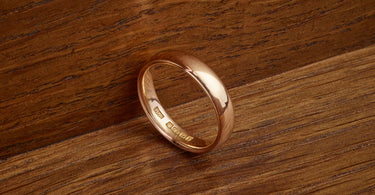
Gold date stamp on the inside of a 22-carat Gold vintage wedding ring, sometimes stamped 916. Notice the small letter at the end held within the cartouche, signifying a year date for the hallmark.
What is a hallmark date letter?
A date letter is a single character stamped alongside the other marks on precious metal. It records the year the item was tested and hallmarked at an assay office. The idea goes back a long way: London began using date letters in 1478.
Each alphabet runs through the letters in order, one per year, then starts again in a new style. So a letter "P" might be a plain capital in one century, a lowercase serif in another and an italic in a third. Over time you will see:
- plain capitals with clean, straight edges
- lowercase letters, sometimes quite decorative
- serif letters with small finishing strokes
- italic or script forms that look almost handwritten
- Gothic or black-letter forms on very old pieces
The letter sits inside a small outline, called a shield or cartouche, and the shape of that outline is part of the clue. Square, clipped corners, rounded, pointed base: each belongs to a particular period. That is why you match the whole stamp, not just the letter.
The other marks you will find beside it
A British gold hallmark is usually a small group of stamps, and the date letter only makes sense in context.
The sponsor's (or maker's) mark. Initials in a shaped outline, identifying who submitted the piece for hallmarking. It isn't always the person who physically made it.
The fineness mark. The purity of the gold:
- 375: 9 carat (37.5% gold)
- 585: 14 carat (58.5%)
- 750: 18 carat (75%)
- 916: 22 carat (91.6%)
Older pieces often show the carat as a plain number, such as 9 or 18, usually with a crown, rather than the three-digit form.
The assay office mark. Which office tested the piece. This is your starting point for dating it.
The date letter. Where present, the year of hallmarking.
Which assay office? Check the symbol first
Before you open a chart, work out where the piece was hallmarked. Each office has its own symbol, and before 1975 each kept its own date-letter sequence.
|
Assay office |
Symbol on gold |
|---|---|
|
Birmingham |
Anchor |
|
London |
Leopard's head |
|
Sheffield |
Crown on older marks, rose from 1975 |
|
Edinburgh |
Castle |
|
Chester (closed 1962) |
Three wheatsheaves and a sword |
|
Glasgow (closed 1964) |
Tree, bird, bell and fish |
A common mix-up: the lion you may have seen on British silver is the lion passant, which is a sterling silver standard mark. It does not mean London. On gold, London's mark is the leopard's head, a small stylised animal face, which may carry a tiny crown on older pieces. If you see a leopard's head, you are looking at London hallmarking.
Chester is a lovely one to find. The office closed in 1962, so the mark alone tells you the piece is at least that old.
How to read a date letter chart

Our date letter reference chart, showing the alphabets, letter styles and shield shapes used to identify the year of hallmarking. (1965 - 2019)
For earlier pieces, we've included an additional hallmark reference via this link. This is particularly useful when researching Victorian and Edwardian jewellery, where the style of the date letter and its surrounding cartouche can be quite different from later examples.
Work through it in this order:
- Pick the right office and period. Before 1975, each office has its own chart. From 1975 the four remaining offices (London, Birmingham, Sheffield and Edinburgh) share one common date letter each year.
- Identify the letter. Be honest about what you can actually see. Shallow, worn stamps are easy to misread.
- Note the style. Capital or lowercase? Plain, serif, italic?
- Check the shield. Look at the corners and the base.
All three should agree with the chart. If the letter fits but the shield doesn't, don't talk yourself into it. Look at another period.
Real examples from our bench
Charts are fine, but the real thing is rarely as tidy. Here are 2 of the kinds of marks we see.
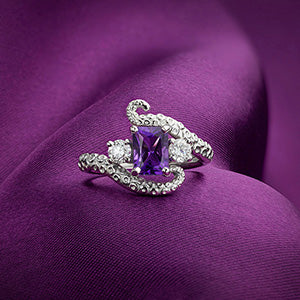
Example 1: a contemporary Amethyst dress ring

Hallmark: Birmingham, 9ct Gold (375), Date letter "e" = 2004
Wider band engagement rings and wedding rings are usually the easiest to read, because the marks sit inside the band, protected from the worst knocks. But decades of wear, resizing and polishing take their toll. It is common for the purity mark to be crisp while the date letter has almost gone.
On examining this particular ring, the lowercase 'e' immediately suggested a more recent hallmark. Comparing its lettering and surrounding cartouche with the Birmingham Assay Office chart confirmed the hallmarking year as 2004.

Example 2: Vintage Gold Goat Charm

Hallmark: 9ct .375 Birmingham Assay Office, "U" 1969 Date Stamp
Small pieces are awkward. The marks may be squeezed onto a tiny surface, or stamped on the bail or the jump ring, so you have to go looking for them. A clear close-up and some patience make all the difference.
In addition, slight variations in the style of lettering can be very difficult to detect.

Does the date letter tell you when the piece was made?
Not exactly. It records the year of hallmarking, and the two are usually close but not always identical. A piece might sit in a workshop before it is sent to the assay office, or be altered and re-submitted later.
So "hallmarked in 1958" is the accurate way to put it, rather than "made in 1958". It is a small difference in wording, but it matters when you are describing antique or vintage pieces honestly.
Why some gold jewellery has no date letter
Since 1 January 1999, the date letter has been optional on British hallmarks. A modern ring can be perfectly legal and perfectly genuine without one. The three compulsory elements now are the sponsor's mark, the fineness mark and the assay office mark.
So a missing date letter is not a red flag on its own. Older pieces can also lose part of the hallmark through wear, repair or resizing. When there is no date letter, you can still form a rough idea of age from the style of the marks, the construction, the setting and the design, but treat that as an estimate, not proof.
However, without any evidence of a date stamp, some items are easily identified and can be approximately dated by their design, patina and even gold colouration (such as Crown Gold with its pinkish hues.)
Reading a worn or faint hallmark
Every jeweller knows the frustration of a hallmark that is almost, but not quite, readable. A ring worn daily for fifty years, rubbing against its neighbours, loses detail.
Some things that help:
- Use a loupe, around 10x magnification.
- Use a single, directional light source rather than a bright overhead one.
- Tilt and rotate the piece slowly. The shadows inside a shallow stamp change dramatically as the angle shifts, and a letter that was invisible will often appear.
- Photograph the mark with a macro setting and enlarge it. Your eye may see more on screen than in your fingers.
- Look at the whole group of marks, not just the letter.
And please don't polish the area or scratch at it. Removing metal can wipe out the very thing you are trying to read. If it stays unclear, record the date as uncertain rather than forcing a match.
Can you date gold from the 375 or 750 stamp alone?
No. Those numbers describe purity (9 carat and 18 carat), not age. They appear on jewellery from many different decades. Likewise a simple 9K, 14K or 18K stamp doesn't mean a piece was hallmarked in Britain. It may just be a statement of gold content, without the full set of marks of a British assay office.
Does age affect the value of gold jewellery?
Sometimes, but an old hallmark doesn't automatically mean a valuable piece. What counts:
- gold content and weight
- condition and quality of craftsmanship
- rarity of the design
- period and original features
- maker
- gemstones and settings
- collector demand
A well-preserved Edwardian ring may command a premium over a modern equivalent. An ordinary vintage wedding band, on the other hand, is mostly worth its gold. What a clear hallmark does give you is confidence: you know the purity, you know roughly when, and you know it's been independently tested.
Frequently asked questions
What does the letter inside my gold ring mean?
If it's part of a British hallmark, it is probably the date letter for the year the ring was hallmarked. But initials can also form part of a maker's mark, so check the surrounding stamps.
Can the same letter mean different years?
Yes. The alphabets have been reused over the centuries, so one letter can stand for several years. The style, the shield and the assay office tell you which.
What is the date letter for 2026?
The UK date letter for 2026 is B, in the alphabet that began in 2025. It's worth double-checking against the current assay office chart.
When did date letters become optional?
1 January 1999. Many pieces still carry one, particularly where the maker or customer wants to mark a particular year.
Can I date an antique gold ring with no hallmark?
Often only approximately. A jeweller can assess construction, setting style, design and gold colour to estimate a period, but without a hallmark or provenance an exact year is usually impossible.
The story inside the stamp
Part of the pleasure of this job is the history hiding in small details. A plain wedding ring may have passed through three generations. A charm may have been a birthday present half a century ago. Quite often the hallmark is the only surviving record of when.
When we refurbish items of gold jewellery, we carefully assess each piece to identify its hallmark. This helps us to date and determine the origin, Assay Office and fineness. At the same time, we do our very best to refurbish without losing the hallmark if it is already difficult to read.
When we list pre-loved jewellery at Isle of Wight Jewellery, we describe the hallmarks wherever we can, so you know not only the gold content but the age and character of what you're buying.
Explore our collection of pre-loved gold jewellery, including vintage rings, speciality antique charms, chains and pieces with histories of their own.


